 |
TurtleBrains
0.3.5
High quality, portable, C++ framework for rapid 2D game development.
|


|
|
TurtleBrains
0.3.5
High quality, portable, C++ framework for rapid 2D game development.
|
|
#include <tb_texture_manager.hpp>
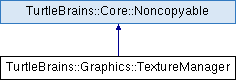
Public Member Functions | |
| TextureHandle | CreateTextureFromFile (const String &filename, const bool mipmapped=true) |
| TextureHandle | CreateTextureFromFileData (const unsigned char *fileDataInMemory, const tbCore::uint32 fileSizeInBytes, const bool mipmapped=true) |
| TextureHandle | CreateTextureFromPixelData (const PixelSpace &textureWidth, const PixelSpace &textureHeight, const TextureFormat &format, const unsigned char *pixelData, const bool mipmapped=true) |
| TextureHandle | CreateTextureEmpty (const PixelSpace &textureWidth, const PixelSpace &textureHeight, const TextureFormat &format=TextureFormat::ColorARGB8) |
| TextureHandle | CreateTextureReference (const TextureHandle &textureHandle) |
| void | DestroyTexture (const TextureHandle &textureHandle) |
| void | BindTexture (const TextureHandle &textureHandle) |
| void | BindTexture (const TextureHandle &textureHandle, tbCore::uint8 textureUnit) |
| PixelSpace | GetTextureWidth (const TextureHandle &textureHandle) const |
| PixelSpace | GetTextureHeight (const TextureHandle &textureHandle) const |
| void | SetTextureWrapMode (const TextureHandle &textureHandle, TextureWrapMode wrapMode) |
| void | SetTextureWrapMode (const TextureHandle &textureHandle, TextureWrapMode wrapModeU, TextureWrapMode wrapModeV) |
| void | SetTextureFiltering (const TextureHandle &textureHandle, TextureFilter filter) |
| void | CheckAndReloadTextures (void) |
| void | Unstable_RunSoftwareShader (const TextureHandle &textureHandle, std::function< tbCore::uint32(PixelSpace x, PixelSpace y, tbCore::uint32)> shader) |
| tbCore::uint64 | ComputeMemoryUsage (void) const |
| void | CreateGraphicsContext (void) |
| void | DestroyGraphicsContext (void) |
Static Public Member Functions | |
| static void | PreMultiplyAlpha (tbCore::byte *imageData, const PixelSpace &imageWidth, const PixelSpace &imageHeight) |
Friends | |
| class | Implementation::TextureManagerCreator |
A basic texture manager to load images from disk or file/pixel data in memory while using a caching technique so using the same file path will not create more textures. TurtleBrains makes use of Sean Barrett's stb_image API to process the file, which supports the following file formats with some limitations:
| void TurtleBrains::Graphics::TextureManager::BindTexture | ( | const TextureHandle & | textureHandle | ) |
Binds the texture associated with the textureHandle to the GL context for rendering calls. An error condition will be triggered if textureHandle is the handle was not initialized or the associated texture has been destroyed.
| textureHandle | of the texture to apply to the GL context. |
| void TurtleBrains::Graphics::TextureManager::BindTexture | ( | const TextureHandle & | textureHandle, |
| tbCore::uint8 | textureUnit | ||
| ) |
Binds the texture associated with the textureHandle to the GL context for rendering calls. An error condition will be triggered if textureHandle is the handle was not initialized or the associated texture has been destroyed.
| textureHandle | of the texture to apply to the GL context. |
| textureUnit | Which texture unit will be the handle be bound to. |
| void TurtleBrains::Graphics::TextureManager::CheckAndReloadTextures | ( | void | ) |
For hot-reloading support.
| tbCore::uint64 TurtleBrains::Graphics::TextureManager::ComputeMemoryUsage | ( | void | ) | const |
Returns the number of bytes in memory from all textures currently loaded in the manager/texture cache.
| void TurtleBrains::Graphics::TextureManager::CreateGraphicsContext | ( | void | ) |
When a new Graphics Context is created this should be called to allow the TextureManager to reload any managed textures to the context, and create any generated textures for generaly use like the Blank Texture.
| TextureHandle TurtleBrains::Graphics::TextureManager::CreateTextureEmpty | ( | const PixelSpace & | textureWidth, |
| const PixelSpace & | textureHeight, | ||
| const TextureFormat & | format = TextureFormat::ColorARGB8 |
||
| ) |
Creates a texture with specified width and height then sets all the pixels to white. Textures created empty do not get cached, so be aware that calling this several times with the same width/height will create new textures. Any texture created must be cleaned up by calling DestroyTexture().
| textureWidth | is the width of the texture to be created, in pixels, must be greater than 0. |
| textureHeight | is the height of the texture to be created, in pixels, must be greater than 0. |
| TextureHandle TurtleBrains::Graphics::TextureManager::CreateTextureFromFile | ( | const String & | filename, |
| const bool | mipmapped = true |
||
| ) |
Checks the cache if the file has already been opened, if not, the file will be opened from disk and processed creating an ARGB texture with OpenGL. Any texture created must be cleaned up by calling DestroyTexture. Although the texture may not actually be destroyed if there are still others referencing the texture object (via other calls to CreateTextureFromFile).
| filename | the path of the file to open and process. |
| mipmapped | determines if the texture should be mipmapped or not. |
| TextureHandle TurtleBrains::Graphics::TextureManager::CreateTextureFromFileData | ( | const unsigned char * | fileDataInMemory, |
| const tbCore::uint32 | fileSizeInBytes, | ||
| const bool | mipmapped = true |
||
| ) |
Creates a texture from the data of a file already in memory, this is not the uncompressed pixel data. Textures created from file data do not get cached, so be aware that calling this several times with the same file data will create new textures. Any texture created must be cleaned up by calling DestroyTexture().
| fileDataInMemory | should contain an entire supported file in memory which can be removed after the call. |
| fileSizeInBytes | is how many bytes make up the file. |
| mipmapped | determines if the texture should be mipmapped or not. |
| TextureHandle TurtleBrains::Graphics::TextureManager::CreateTextureFromPixelData | ( | const PixelSpace & | textureWidth, |
| const PixelSpace & | textureHeight, | ||
| const TextureFormat & | format, | ||
| const unsigned char * | pixelData, | ||
| const bool | mipmapped = true |
||
| ) |
Creates a texture from the data of each pixel color, this is the uncompressed 32bit ARGB pixel data format. A 1x1 texture would be 4 bytes, first byte Alpha, second Red, then Green and final byte Blue. Textures created from pixel data do not get cached, so be aware that calling this several times with the same pixel data will create new textures. Any texture created must be cleaned up by calling DestroyTexture().
| textureWidth | is the width of the supplied pixelData in pixels wide, must be greater than 0. |
| textureHeight | is the height of the supplied pixelData in pixels tall, must be greater than 0. |
| format | What format the texture should be (as well, somewhat, the input; may be mixed for formats that have partial bytes, like A2R5G5B3 might actually want input of A8R8G8B8 for simplicity...) |
| pixelData | must contain at least (textureWidth * textureHeight * 4) bytes of data for each pixel assuming a texture format of ColorARGB8. For any float textures, provide a float32 per pixel/channel and it will be converted as it loads into the GPU. |
| mipmapped | determines if the texture should be mipmapped or not. |
| TextureHandle TurtleBrains::Graphics::TextureManager::CreateTextureReference | ( | const TextureHandle & | textureHandle | ) |
This does not actually create a texture but will increase the reference count so it does not get unloaded/cleaned on the call to DestroyTexture. This is meant to allow textured created by file data or pixel data to be shared more easily in the reference counted manner. Any texture created must be cleaned up by calling DestroyTexture().
| textureHandle | The texture associated with this handle will increment the reference count and be returned back. Must be a valid TextureHandle or an error condition will be triggered. |
| void TurtleBrains::Graphics::TextureManager::DestroyGraphicsContext | ( | void | ) |
This should be called just before the graphics context is destroyed so the TextureManager can cleanup any resources and deal with the managed textures.
| void TurtleBrains::Graphics::TextureManager::DestroyTexture | ( | const TextureHandle & | textureHandle | ) |
Decrements the textures reference count and if needed will destroys the texture, removing it from the OpenGL pipeline and cleaning any other associated resources. Each texture handle is reference counted, so every call to Create needs a matching call to destroy.
| textureHandle | of the texture to destroy and remove completely from the GL context and TextureManager. |
| PixelSpace TurtleBrains::Graphics::TextureManager::GetTextureHeight | ( | const TextureHandle & | textureHandle | ) | const |
Returns the width of the texture associated with the textureHandle provided. If InvalidTexture() is provided 0 will be returned. An error condition will be triggered if textureHandle is the handle was not initialized or the associated texture has been destroyed.
| PixelSpace TurtleBrains::Graphics::TextureManager::GetTextureWidth | ( | const TextureHandle & | textureHandle | ) | const |
Returns the width of the texture associated with the textureHandle provided. If InvalidTexture() is provided 0 will be returned. An error condition will be triggered if textureHandle is the handle was not initialized or the associated texture has been destroyed.
|
static |
This will take the imageData in ARGB format, and pre-multiplies the RGB channels by the alpha channel since the TurtleBrains shader and blend mode is set for premultiplied alpha.
| imageData | The data to be modified in place. |
| imageWidth | The width of the image in pixels. |
| imageHight | The height of the image in pixels. |
| void TurtleBrains::Graphics::TextureManager::SetTextureWrapMode | ( | const TextureHandle & | textureHandle, |
| TextureWrapMode | wrapMode | ||
| ) |
Set the TextureWrapMode for a specific texture to change how the U and V coordinates behave outside the 0 to 1 range.
@parameter textureHandle The texture to change the wrap mode for, if not bound this may incur state changes but previously bound texture will remain bound after finished. @parameter wrapMode The mode to use for both U and V coordinates. @parameter wrapModeU The mode to use for the horizontal U coordinates. @parameter wrapModeV The mode to use for the vertical V coordinates.
| void TurtleBrains::Graphics::TextureManager::SetTextureWrapMode | ( | const TextureHandle & | textureHandle, |
| TextureWrapMode | wrapModeU, | ||
| TextureWrapMode | wrapModeV | ||
| ) |
Set the TextureWrapMode for a specific texture to change how the U and V coordinates behave outside the 0 to 1 range.
@parameter textureHandle The texture to change the wrap mode for, if not bound this may incur state changes but previously bound texture will remain bound after finished. @parameter wrapMode The mode to use for both U and V coordinates. @parameter wrapModeU The mode to use for the horizontal U coordinates. @parameter wrapModeV The mode to use for the vertical V coordinates.
 1.9.1
1.9.1